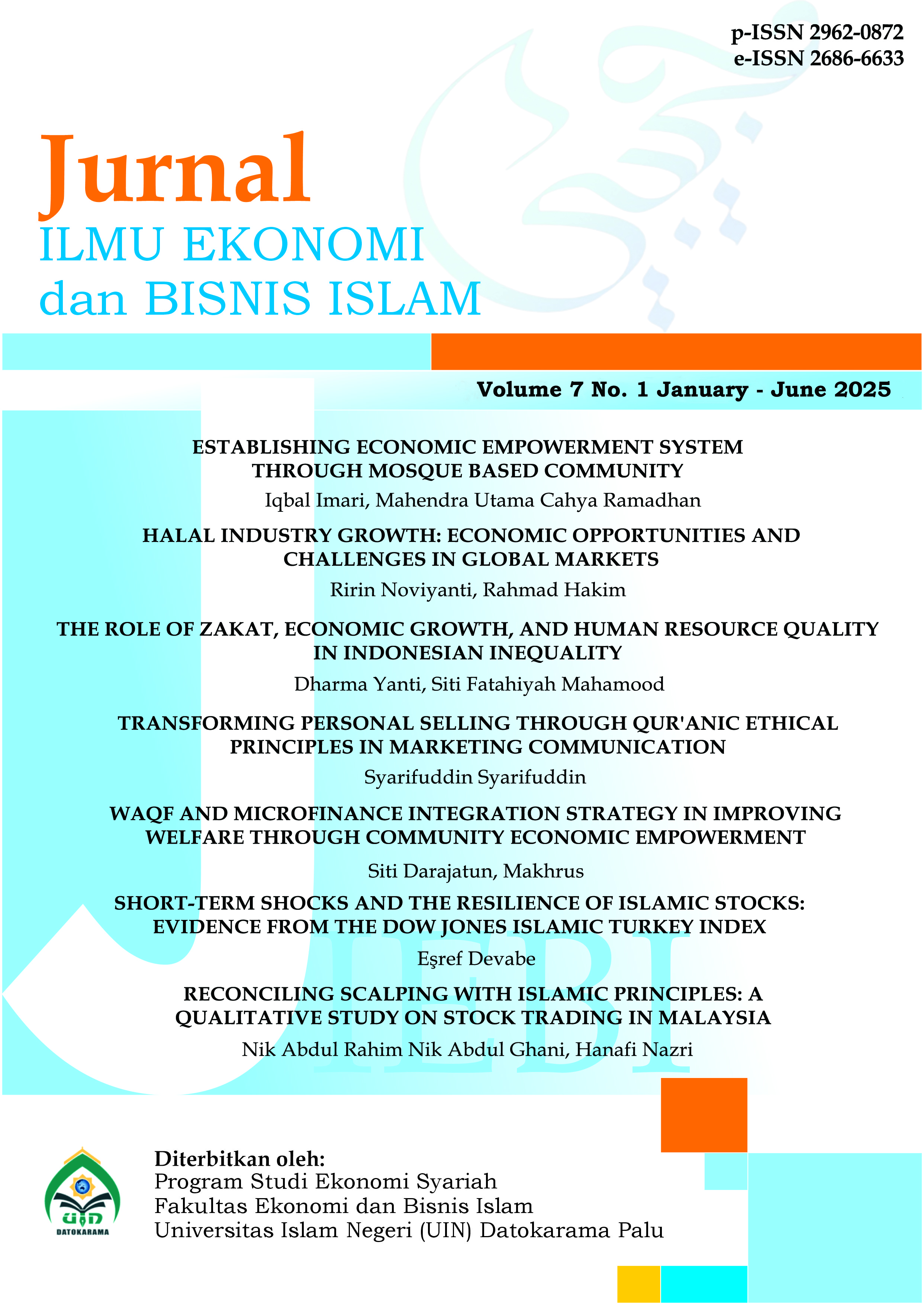
Reconciling Scalping With Islamic Principles: A Qualitative Study on Stock Trading In Malaysia
DOI:
https://doi.org/10.24239/jiebi.v7i1.355.105-122Keywords:
Scalping, Shariah Compliance, Fiqh Muʿāmalāt, Islamic Finance, SpeculationAbstract
Scalping, a high-frequency trading strategy characterized by rapid buy-and-sell transactions to capture small price movements, has become increasingly common in modern stock markets. Its legitimacy under Islamic commercial jurisprudence (fiqh muʿāmalāt), however, remains debated due to potential elements of maysir (gambling), gharar (excessive uncertainty), and bayʿ al-najash (deceptive bidding). Addressing the lack of focused research on this issue within Malaysia’s Islamic capital market, this study employs a qualitative descriptive approach through document analysis of classical jurisprudential texts, contemporary academic literature, and regulatory fatwas issued by recognized Shariah authorities. Using the takyīf fiqhī method, the analysis examines the ethical and legal dimensions of scalping to determine whether it conforms to Shariah principles. The findings reveal that although scalping carries speculative elements, it may be considered conditionally permissible (mubāḥ) when conducted transparently, guided by informed analysis, and devoid of manipulative intent. The study concludes that scalping is not inherently prohibited in Islam but requires ethical discipline and regulatory oversight to prevent exploitation. The research contributes to refining Shariah-compliant trading practices, offering practical implications for Muslim investors, Shariah scholars, and regulators in strengthening ethical governance within Malaysia’s dynamic Islamic financial system.
References
Abedifar, P. (2023). Formalism versus Purposivism in Islamic Jurisprudence: The Case of Islamic Finance Law. Religions, 14(4). https://doi.org/10.3390/rel14040465
Ahmad, A. A., & Adnan, N. I. M. (2017). Isu Spekulasi dan Perjudian dalam Urus Niaga Saham Secara Kontra. Islamiyyat : Jurnal Antarabangsa Pengajian Islam; International Journal of Islamic Studies, 39(2), 103–111. https://doi.org/10.17576/islamiyyat-2017-3902-02
Ahmad, A. A., & Halim, M. A. A. (2014). The concept of hedging in islamic financial transactions. Asian Social Science, 10(8), 42–49. https://doi.org/10.5539/ass.v10n8p42
Ahmad, M., & Ansary, R. (2017). Fiqhī views on bayʿwa salaf and qarḍ-based Islamic banking deposit accounts in Malaysia. ISRA International Journal of Islamic Finance, 9(1), 106–112. https://doi.org/10.1108/ijif-07-2017-011
Ahmadvand, M., & Tamalloki, H. (2017). Using VIKOR method to prioritise sharia-compliant equivalents for short selling (based on evidence of Iran’s stock market). Afro-Asian Journal of Finance and Accounting, 7(3), 281–303. https://doi.org/10.1504/AAJFA.2017.085560
Ahmed, A. (2020). Socially responsible investing (SRI) interconnect with the supply Chain strategy in Islamic Finance Model (IFM). International Journal of Supply Chain Management, 9(1), 943–951. https://www.scopus.com/inward/record.uri?eid=2-s2.0-85075239067&partnerID=40&md5=feba41055d6a2c0b72d39bf554238f0f
Ainiah, P. (2023). Kajian Trading Saham Syariah Di Bursa Efek Indonesia. Jurnal Ilmiah Ekonomi Islam, 9(1), 1322–1328. https://jurnal.stie-aas.ac.id/index.php/jei/article/view/6920
Al-Awadhi, A. M., Bash, A., AlGharabali, B., Al-Hashel, M., & Jamaani, F. (2024). Religious practices, fasting, and individuals’ trading behavior: a natural experiment. Journal of Islamic Accounting and Business Research. https://doi.org/10.1108/JIABR-06-2023-0172
Al-Bukhari, A. `Abd A. b. M. b. I. (2000). Ṣaḥīḥ al-Bukhārī. In S. b. `Abd al-`Azīz Ā. Al-Shaykh (Ed.), Mawsūʿat al-Ḥadīth al-Sharīf: al-Kutub al-Sittah (Vol. 3). Dār al-Salām.
Al-Haytamī, I. Ḥajar. (1987). Al-Zawājir ʿan iqtirāf al-kabāʿir. Dār al-Fikr.
Al-Qurtubi, A. `Abdillah al-A. (2010). Tafsir Jami’li Ahkam al-Qur’an (5th ed.). Dar al-kutub al-Ilmiyyah.
Al-Ramli. (1967). Nihayat al-Muhtaj Syarh Al-Minhaj. Dar Al-Kutub.
Amsyar Mohd Arif, M. I., & Markom, R. (2020). Isu-Isu Perundangan Dalam Kedudukan Dan Peranan Statutori Majlis Penasihat Syariah Bank Negara Malaysia. Global Journal Al-Thaqafah, 10(2), 84–95. https://doi.org/10.7187/gjat122020-10
Apriantoro, M. S., Anuraga, B., Akbar, H. C., & Rosyadhi, R. I. (2022). Stock Investment with Scalping Trading Method in Islamic Law Perspective. Al-Iktisab: Journal of Islamic Economic Law, 6(2), 121. https://doi.org/10.21111/al-iktisab.v6i2.8269
Arfaoui, M., & Raggad, B. (2023). Do Dow Jones Islamic equity indices undergo speculative pressure? New insights from a nonlinear and asymmetric analysis. International Journal of Finance and Economics, 28(2), 1582–1601. https://doi.org/10.1002/ijfe.2495
Asni, F. (2020). Management of fatwa standardisation on the practice of bay’ ‘inah contract in Malaysia: an analysis according to usul al-Fiqh and mura’aht al-Khilaf method. Qualitative Research in Financial Markets, 13(1), 118–139. https://doi.org/10.1108/QRFM-07-2019-0084
Bains, S. R., & Manjoo, S. F. A. (2021). Impact of the Shift From Real Economy Toward the Financial Economy in Deriving New Rules (Istinbāt) in Mu”Amalāt. In Teaching and Research Methods for Islamic Economics and Finance (pp. 90–110). Routledge. https://doi.org/10.4324/9781003252764-9
Begam, M. R., Babu, M., & Sulphey, M. M. (2024). Development and Validation of an Islamic Investor’s Sentiment Scale for Stock Market Investment. Business Perspectives and Research, 12(1), 26–44. https://doi.org/10.1177/22785337221148888
Berger, N., DeSantis, M., & Porter, D. (2020). The impact of high-frequency trading in experimental markets. Journal of Investing, 29(4), 7–18. https://doi.org/10.3905/joi.2020.1.132
Binti Ahmad, N. A., Aziz, A. H. B. A., & Bin Bahari, Z. (2020). Perkembangan Industri Pelaburan Saham Di Malaysia. Journal of Islamic, Social, Economics and Development, 5(29), 91–99. https://academicinspired.com/jised/article/view/1105
Bulkowski, T. N. (2015). Encyclopedia of Candlestick Charts. In Encyclopedia of Candlestick Charts. https://doi.org/10.1002/9781119202288
Chen, J. H., & Tsai, Y. C. (2020). Encoding candlesticks as images for pattern classification using convolutional neural networks. Financial Innovation, 6(1). https://doi.org/10.1186/s40854-020-00187-0
Chen, V. (2017). Law and Society in the Evolution of Malaysia’s Islamic Capital Market Regulation. Asian Journal of Law and Society, 4(1), 133–156. https://doi.org/10.1017/als.2016.20
Chowdhury, M. A. F., Sultan, Y., & Mahmudul Haque, M. (2020). Conventional futures: A review of major issues from the Islamic finance perspective. International Journal of Pluralism and Economics Education, 11(2), 201–210. https://doi.org/10.1504/IJPEE.2020.111258
Cofnas, A. (2015). The Forex Trading Course: A Self-Study Guide to Becoming a Successful Currency Trader, Second Edition. In The Forex Trading Course: A Self-Study Guide to Becoming a Successful Currency Trader, Second Edition. https://www.scopus.com/inward/record.uri?eid=2-s2.0-85024890319&partnerID=40&md5=8fbae4a91b67dd97e452273cd2c5f094
Courdent, A., & McClelland, D. (2022). The impact of algorithmic trading on market quality: Evidence from the Johannesburg Stock Exchange. Investment Analysts Journal, 51(3), 157–171. https://doi.org/10.1080/10293523.2022.2090056
Delfabbro, P., King, D. L., & Williams, J. (2021). The psychology of cryptocurrency trading: Risk and protective factors. Journal of Behavioral Addictions, 10(2), 201–207. https://doi.org/10.1556/2006.2021.00037
Delfabbro, P., King, D., Williams, J., & Georgiou, N. (2021). Cryptocurrency trading, gambling and problem gambling. Addictive Behaviors, 122. https://doi.org/10.1016/j.addbeh.2021.107021
Emmert, F. (2024). Can Cryptocurrencies Save Islamic Finance? Manchester Journal of Transnational Islamic Law and Practice, 20(3), 317–345. https://www.scopus.com/inward/record.uri?eid=2-s2.0-85212135234&partnerID=40&md5=79b516adb500728814981e10e04d2bb6
Fanesti, S. H., & Madid, I. (2022). Metode Scalping dalam Trading Saham Menggunakan Analisis Teknikal Menurut Hukum Islam. Wasathiyyah, 4(2), 111–132. https://doi.org/10.58470/wasathiyyah.v4i2.35
George, J., Nair, A. M., & Yathish, S. (2022). Analysis of Market Behavior Using Popular Digital Design Technical Indicators and Neural Network. Lecture Notes in Networks and Systems, 209, 445–458. https://doi.org/10.1007/978-981-16-2126-0_37
Ghazali, N. M., Sawari, M. F. M., Ghalia, B., & Alhabshi, S. M. S. J. (2024). the Fiqh Maxim Al-Ghunm Bi Al-Ghurm: a Critique on Interpretation of the Maxim Relating To the Risk-Return Concept in Islamic Banking and Finance. ISRA International Journal of Islamic Finance, 16(2), 4–19. https://doi.org/10.55188/ijif.v16i2.412
Grall-Bronnec, M., Sauvaget, A., Boutin, C., Bulteau, S., Jiménez-Murcia, S., Fernández-Aranda, F., Challet-Bouju, G., & Caillon, J. (2017). Excessive trading, a gambling disorder in its own right? A case study on a French disordered gamblers cohort. Addictive Behaviors, 64, 340–348. https://doi.org/10.1016/j.addbeh.2015.12.006
Håkansson, A., Fernández-Aranda, F., & Jiménez-Murcia, S. (2021). Gambling-Like Day Trading During the COVID-19 Pandemic – Need for Research on a Pandemic-Related Risk of Indebtedness and Mental Health Impact. Frontiers in Psychiatry, 12. https://doi.org/10.3389/fpsyt.2021.715946
Hasan, A. N., Abdul-Rahman, A., & Yazid, Z. (2020). Shariah governance practices at Islamic fund management companies. Journal of Islamic Accounting and Business Research, 11(2), 309–325. https://doi.org/10.1108/JIABR-03-2017-0045
Hassan, M. K., & Hippler, W. J. (2014). Entrepreneurship and Islam: An overview. Econ Journal Watch, 11(2), 170–178. https://doi.org/10.2139/ssrn.3263110
Hassan, R., & Salman, S. A. (2017). Guiding principles in developing Shari’ah governance framework for Islamic capital market. International Journal of Economic Research, 14(6), 27–38. https://www.scopus.com/inward/record.uri?eid=2-s2.0-85019561222&partnerID=40&md5=7a3c960a5bf0211140f44acef6bf1c74
He, S., Zheng, J., Lin, J., Tang, T., Zhao, J., & Liu, H. (2020). Classification-based fraud detection for payment marketing and promotion. Computer Systems Science and Engineering, 35(3), 141–149. https://doi.org/10.32604/csse.2020.35.141
Hidayat, E., & Ahmad, A. U. F. (2023). Legal Maxims of Ba’i Ibn Al-Arabi’s Contract and Their Relevance to Contemporary Muamalah Maliah Issues. Jurnal Hukum Islam, 21(1), 1–28. https://doi.org/10.28918/jhi_v21i1_01
Ishak, M. S. I. (2019). The principle of maṣlaḥah and its application in Islamic banking operations in Malaysia. In ISRA International Journal of Islamic Finance (Vol. 11, Issue 1). https://doi.org/10.1108/IJIF-01-2018-0017
Kamolsareeratana, A., & Kouwenberg, R. (2023). Compulsive Gambling in the Stock Market: Evidence from an Emerging Market. Economies, 11(1). https://doi.org/10.3390/economies11010028
Kasri, N. S., Rahman, Z. A., Mohamad, S., & Habib, F. (2016). Issues in Islamic Hedging Practices: a Critical Analysis. ISRA International Journal of Islamic Finance, 8(2), 105–109. https://www.scopus.com/inward/record.uri?eid=2-s2.0-85165659996&partnerID=40&md5=45734a7c9442a399a0159ab1310a54d3
Kathirvelu, S., & Abd Rahman, M. R. (2024). ANALISA TERHADAP UNDANG-UNDANG PERJUDIAN DALAM TALIAN DI MALAYSIA (Analysis on the Online Gambling Laws in Malaysia). UUM Journal of Legal Studies, 15(1), 329–360. https://doi.org/10.32890/uumjls2024.15.1.14
Kitamura, H. (2022). The historical contingency of religious normativity Local practices in Malaysian Islamic banking. HAU: Journal of Ethnographic Theory, 12(2), 513–524. https://doi.org/10.1086/720511
Kunhibava, S. (2015). Legal Issues in Sharīʿah Governance in the Islamic Finance Industry in Malaysia. ISRA International Journal of Islamic Finance, 7(2), 55–80. https://www.scopus.com/inward/record.uri?eid=2-s2.0-85069538314&partnerID=40&md5=15738a57f0b1a0b258b04ca040ab5f35
Manahov, V. (2016a). A note on the relationship between high-frequency trading and latency arbitrage. International Review of Financial Analysis, 47, 281–296. https://doi.org/10.1016/j.irfa.2016.06.014
Manahov, V. (2016b). Can High-frequency Trading Strategies Constantly Beat the Market? International Journal of Finance and Economics, 21(2), 167–191. https://doi.org/10.1002/ijfe.1541
Manahov, V. (2016c). Front-Running Scalping Strategies and Market Manipulation: Why Does High-Frequency Trading Need Stricter Regulation? Financial Review, 51(3), 363–402. https://doi.org/10.1111/fire.12103
Mazri, K. F., Ismail, R. F., Arshad, R., & Kamaruzaman, S. A. (2018). Corporate governance attributes as determinants of the Islamic Social Reporting of Shariah-compliant companies in Malaysia. International Journal of Economics and Management, 12(Special Issue 1), 169–180. https://www.scopus.com/inward/record.uri?eid=2-s2.0-85060544509&partnerID=40&md5=7b399df084695f78640e472ad4dcb57f
McInish, T. H., Nikolsko-Rzhevska, O., Nikolsko-Rzhevskyy, A., & Panovska, I. (2020). Fast and slow cancellations and trader behavior. Financial Management, 49(4), 973–996. https://doi.org/10.1111/fima.12298
Miah, M. D., & Suzuki, Y. (2018). A critique to a naïve critique to ‘murabaha’ ‘tawarruq’ syndrome. In Y. Suzuki & M. D. Miah (Eds.), Dilemmas and Challenges in Islamic Finance: Looking at Equity and Microfinance. Routledge. https://doi.org/10.1201/9781315105673
Mohd Noh, M. S., Nor Azelan, S. H., & Zulkepli, M. I. S. (2025). A review on Gharar dimension in modern Islamic finance transactions. Journal of Islamic Accounting and Business Research, 16(5), 976–989. https://doi.org/10.1108/JIABR-01-2023-0006
Naughton, S., & Naughton, T. (2000). Religion, ethics and stock trading: The case of an Islamic equities market. Journal of Business Ethics, 23(2), 145–159. https://doi.org/10.1023/A:1006161616855
Nehad, A., & Khanfar, A. (2016). A critical analysis of the concept of gharar in Islamic financial contracts: Different perspective. Journal of Economic Cooperation and Development, 37(1), 1–23. https://www.scopus.com/inward/record.uri?eid=2-s2.0-84971619655&partnerID=40&md5=001f1abf87849ffd8c4352d7fa4624f9
Ngaha, R. P., & Moungou Mbenda, S. P. (2024). Bank employees’ perception of Islamic finance in a non-Islamic developing country: the case of Cameroon. Journal of Islamic Accounting and Business Research, 15(6), 897–910. https://doi.org/10.1108/JIABR-06-2022-0142
Nienhaus, V. (2011). Islamic finance ethics and Shari’ah law in the aftermath of the crisis: Concept and practice of Shari’ah compliant finance. Ethical Perspectives, 18(4), 591–623. https://doi.org/10.2143/EP.18.4.2141849
Nison, S. (2015). Strategies for Profiting With Japanese Candlestick Charts. In Strategies for Profiting With Japanese Candlestick Charts. https://doi.org/10.1002/9781119204541
Nor, F. M., Shaharuddin, A., Marzuki, A., & Ramli, N. A. (2019). Revised Malaysian Shariah screening: Its impact on Islamic capital market. Research in World Economy, 10(1), 17–30. https://doi.org/10.5430/rwe.v10n1p17
Nordin, N., Embong, R., Daud, N., Ismail, S. K., Salleh, S. F., & Ahmad, A. A. (2019). The Islamic ethical principles in commodity derivatives contracts. Journal of Legal, Ethical and Regulatory Issues, 22(Special Issue 1), 1–5. https://www.scopus.com/inward/record.uri?eid=2-s2.0-85076959176&partnerID=40&md5=64ccb689ca6f2e6b23793755293a0e18
Oliver, J. (2013). Day Trading For Dummies. In Journal of Chemical Information and Modeling (3rd Editio, Vol. 53, Issue 9). John Wiley & Sons, Inc.
Omar, A., & Jaffar, M. M. (2016). The continuous model of stochastic mudharabah investment. Pertanika Journal of Social Sciences and Humanities, 24(October), 83–92. https://www.scopus.com/inward/record.uri?eid=2-s2.0-85013447091&partnerID=40&md5=d7f7285c22c55bd77a79ae3a772de4f7
Ong, E. (2016). Technical Analysis for Mega Profit. In PT Gramedia Pustaka Utama. PT Gramedia Pustaka Utama.
Pickering, D., Blaszczynski, A., Hartmann, M., & Keen, B. (2016). Fantasy Sports: Skill, Gambling, or Are These Irrelevant Issues? Current Addiction Reports, 3(3), 307–313. https://doi.org/10.1007/s40429-016-0111-1
Prasetijo, A. B., Saputro, T. A., Windasari, I. P., & Windarto, Y. E. (2017). Buy/sell signal detection in stock trading with bollinger bands and parabolic SAR: With web application for proofing trading strategy. Proceedings - 2017 4th International Conference on Information Technology, Computer, and Electrical Engineering, ICITACEE 2017, 2018-Janua, 41–44. https://doi.org/10.1109/ICITACEE.2017.8257672
Ramdhani, M. R. J. (2020). Tinjauan hukum ekonomi syariah terhadap transaksi yang dilakukan oleh Scalper Pasar Modal di MNC Sekuritas Bandung. https://digilib.uinsgd.ac.id/37750/
Razif, N. F. M., Samsulkamal, N. S., & Ahmad, R. (2021). Takyif Fiqhi terhadap Konsep Spekulasi. Islamiyyat, 43(2), 81–92. https://doi.org/10.17576/islamiyyat-2021-4302-07
Renie, E., Iska, S., Thaidi, H. A. A., & Yusof, U. A. B. (2022). TAFRIQ AL-HALAL ‘AN AL-HARAM THEORY IN THE SELECTION OF SHARIA STOCKS: The Comparative Study in The Sharia Capital Market in Indonesia and Malaysia. Jurisdictie: Jurnal Hukum Dan Syariah, 13(1), 128–142. https://doi.org/10.18860/j.v13i1.17044
Salleh, S., Kamaruddin, M. I. H., Shafii, Z., Hanefah, M. M., Zakaria, N., Mahyudin, W. A., & Sabri, N. A. M. (2024). Shariah Governance and Audit Practices in Islamic Co-Operatives: an Audit Expectation-Performance Gap Analysis. Corporate Law and Governance Review, 6(3), 72–80. https://doi.org/10.22495/clgrv6i3p8
Seddon, J. J. J. M., & Currie, W. L. (2017). A model for unpacking big data analytics in high-frequency trading. Journal of Business Research, 70, 300–307. https://doi.org/10.1016/j.jbusres.2016.08.003
Shabbir, M. S., Ghazi, M. S., & Akhtar, T. (2016). The relationship between traditional as well as modern modes of financial instruments for international market through Islamic finance. Journal of Internet Banking and Commerce, 21(1). https://www.scopus.com/inward/record.uri?eid=2-s2.0-84963783813&partnerID=40&md5=88df89eab749c63937ab6dc1ef9281ef
Shimizu, Y. (2015). Reading Candlestick Charts. In Breakthroughs in Technical Analysis: New Thinking from the World’s Top Minds (pp. 51–82). https://doi.org/10.1002/9781119204749.ch4
Sifat, I. M., & Mohamad, A. (2016). Selling short as ijarah with istihsan and its ethical implication. Arab Law Quarterly, 30(4), 357–377. https://doi.org/10.1163/15730255-12341324
Singh, A. K., Vaibhav, Prasad, K. D. V., Patil, M., & Gharat, C. A. S. (2023). Cryptocurrency and its Psychological Impact on Human Behaviour. Journal for ReAttach Therapy and Developmental Diversities, 6(4), 359–368. https://jrtdd.com/index.php/journal/article/view/453
Smirnova, O. V., & Kotlyar, V. Y. (2019). Some Models of Exchange Trading in High-Risk Financial Markets. Cybernetics and Systems Analysis, 55(4), 661–666. https://doi.org/10.1007/s10559-019-00175-y
Smolarski, J., Schapek, M., & Tahir, M. I. (2006). Permissibility and use of options for hedging purposes in islamic finance. Thunderbird International Business Review, 48(3), 425–443. https://doi.org/10.1002/tie.20103
Song, S. I., Chu, E. Y., & Lai, T. S. (2018). Characteristics and strategies of a consistently profitable proprietary day trader at bursa malaysia. Management and Accounting Review, 17(3), 109–130. https://doi.org/10.24191/mar.v17i3.818
Soualhi, Y., & Bouhraouia, S. (2018). Islamic finance regulations in Malaysia: A macro maqasidic approach. Al-Shajarah, Special Issue: ISLAMIC BANKING AND FINANCE, 307–336. https://www.scopus.com/inward/record.uri?eid=2-s2.0-85060050666&partnerID=40&md5=c2cfcc2823c843c0c14cce7c64dff414
Soualhi, Y., & Hasan Saleh, A. O. (2024). Smart Contracts and Their Application Prospects in Social Banking: a Maqasid Jurisprudential Perspective. Malaysian Journal of Syariah and Law, 12(2), 490–510. https://doi.org/10.33102/mjsl.vol12no2.599
Suruhanjaya Sekuriti Malaysia. (2006). Keputusan Majlis Penasihat Syariah (2nd Edition). In Book Review (Second). http://www.sc.com.my/wp-content/uploads/eng/html/icm/Keputusan_MPS_SC.pdf
Us̲mānī, M. (2002). An introduction to Islamic finance (Vol. 20). Brill.
Velez, O. L. (2015). Swing Trading. In Swing Trading. https://doi.org/10.1002/9781592803644
Waemustafa, W., & Sukri, S. (2016). Theory of gharar and its interpretation of risk and uncertainty from the perspectives of authentic hadith and the holy quran: A qualitative analysis. International Journal of Economic Perspectives, 10(2), 21–33. https://www.scopus.com/inward/record.uri?eid=2-s2.0-85014094194&partnerID=40&md5=67c062943ecd56cd04bf325cdf526f25
Widjaja, M., Ciawi, F., Sekarsari, D., & Tamara, D. (2024). Social Media Usage and Intention to Invest in Securities Crowdfunding in Indonesia. Ultimaccounting Jurnal Ilmu Akuntansi, 16(1), 63–80. https://doi.org/10.31937/akuntansi.v16i1.3500
Woo, M. (2024). Day Trading Performance in High Frequency Trading. Korean Journal of Financial Studies, 53(1), 191–220. https://doi.org/10.26845/KJFS.2024.02.53.1.191
Downloads
Published
Issue
Section
License
All submitted article manuscripts must go through all review stages for the journal Jurnal Ilmu Ekonomi dan Bisnis Islam to accept and publish them. By submitting the manuscript, authors agree to the following terms:
- The authors guarantee that the article is original and has not been previously published. The article does not contain illegal statements and does not infringe upon the rights of others. The authors affirm that the article is entirely their own copyright. If there are quotations or references from other sources, authors must obtain written permission and ensure that the quotations are free from third-party rights.
- Authors retain the copyright to their work and grant the first publication rights to the Jurnal Ilmu Ekonomi dan Bisnis Islam under the Creative Commons Attribution-NonCommercial License 4.0 International (CC BY-NC 4.0). This license allows others to share the work while attributing the authorship and initial publication to this journal. However, commercial use of the work is not permitted.
- Authors are permitted to make additional contractual arrangements for non-exclusive distribution of the published journal version. For example, they may submit the article to an institutional repository or publish it in a book, with acknowledgement of the initial publication in this journal.
- Authors are allowed and encouraged to post their work online before and during the submission process. This is considered to promote productive exchange and early and broader citation of published work (see the Influence of Open Access).
 All articles in the Jurnal Ilmu Ekonomi dan Bisnis Islam are licensed under the Creative Commons Attribution-NonCommercial 4.0 International License.


2.png)