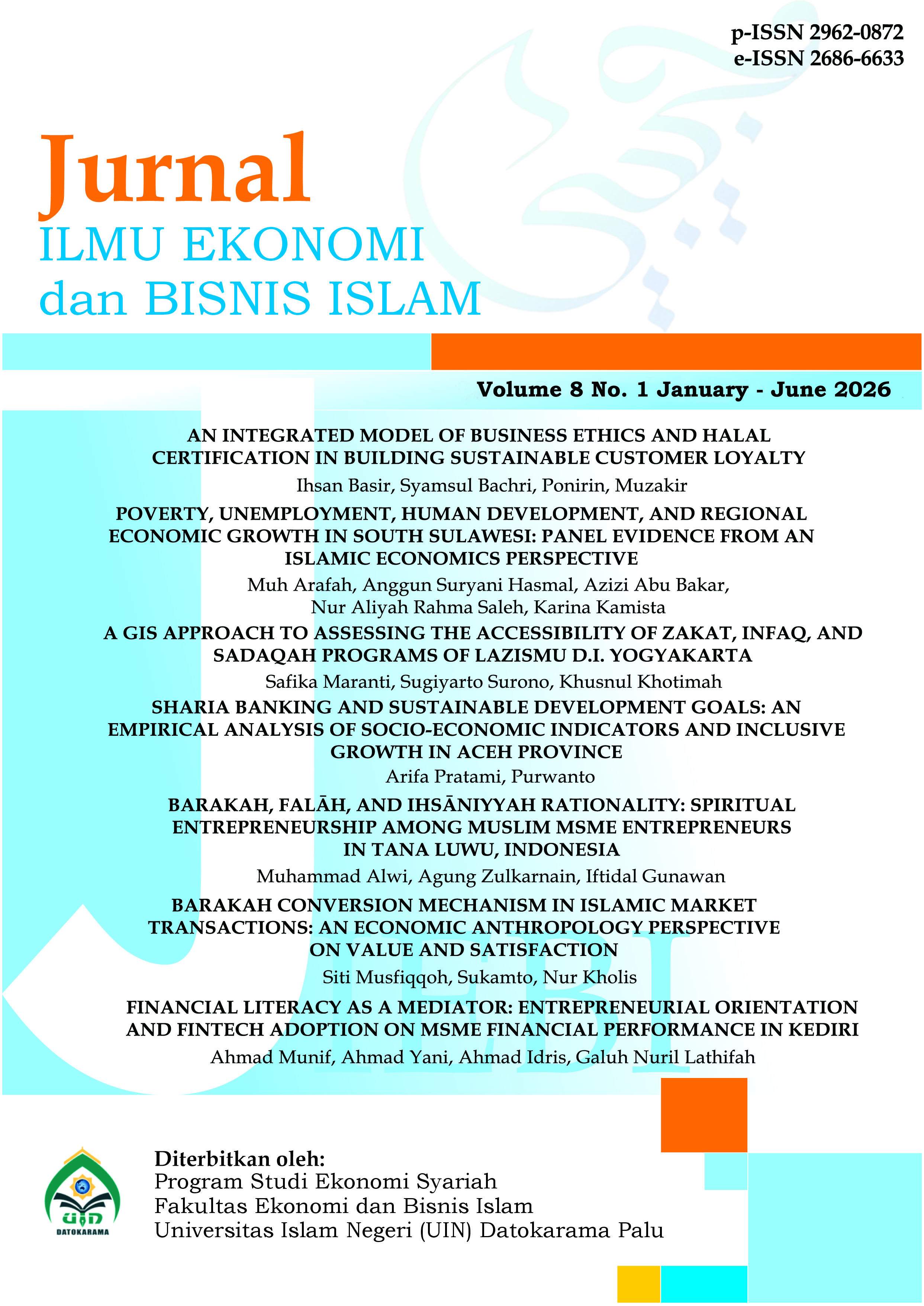
Sharia Banking and Sustainable Development Goals: An Empirical Analysis of Socio-Economic Indicators and Inclusive Growth in Aceh Province
DOI:
https://doi.org/10.24239/jiebi.v8i1.436.45-61Keywords:
Sharia banking, financial intermediation, inclusive growth, sustainable development goals, fiscal paradoxAbstract
This study examines whether Aceh’s mandatory Sharia financial system contributes to SDG-related socio-economic outcomes and inclusive growth during the 2020–2024 period. Although Aceh represents a distinctive jurisdiction-level case of Sharia finance, limited empirical evidence explains how Sharia banking intermediation and regional fiscal policy jointly shape welfare outcomes. This study analyzes balanced panel data from 21 districts/cities in Aceh, comprising 105 district-year observations, using fixed-effects models with robust standard errors applied where heteroskedasticity is detected. The results show that Sharia financing is significantly associated with lower unemployment, indicating its role in strengthening labor absorption through productive financial intermediation. The Financing-to-Deposit Ratio (FDR) is positively associated with the Human Development Index (HDI), suggesting that more active Sharia banking intermediation supports human development. However, regional government expenditure is positively associated with the Gini Ratio, revealing a fiscal paradox in which public spending appears insufficiently redistributive. The study concludes that Aceh’s Sharia financial transformation cannot rely solely on banking intermediation; it requires stronger alignment with inclusive fiscal governance. This research contributes to Islamic economics by showing that ethical financial transformation produces broader welfare effects only when supported by redistributive public policy.
References
Abd-Rahman, N., Mastuki, N., Osman, M. R., & Kasim, N. (2020). Islamic legal maxim for Shari’ah audit in Islamic bank. Journal of Islamic Accounting and Business Research, 11(2), 457–471. https://doi.org/10.1108/JIABR-11-2017-0170
Abdulhakeem, A. K. (2024). Revisiting the nexus between governance and poverty in Sub‐Saharan Africa. Poverty & Public Policy, 16(3), 273–294. https://doi.org/10.1002/pop4.414
Abedifar, P., Hasan, I., & Tarazi, A. (2016). Finance-growth nexus and dual-banking systems: Relative importance of Islamic banks. Journal of Economic Behavior & Organization, 132, 198–215. https://doi.org/10.1016/j.jebo.2016.03.005
Akai, N., & Mikami, K. (2006). Fiscal decentralization and centralization under a majority rule: A normative analysis. Economic Systems, 30(1), 41–55. https://doi.org/10.1016/j.ecosys.2005.08.003
Akhtar, N., & Rashid, A. (2024). Financial development and sustainable development: A review of literature. Sustainable Development, 32(6), 7114–7139. https://doi.org/10.1002/sd.3068
Akhtar, Z. M., Gul, F., & Mubarak, F. (2024). Economic Growth and Financial Intermediation Nexus in Pakistan: An ARDL Analysis. Bulletin of Business and Economics (BBE), 13(1), 542–551. https://doi.org/10.61506/01.00238
Akhter, W., & Khan, S. U. (2017). Determinants of Takāful and conventional insurance demand: A regional analysis. Cogent Economics and Finance, 5(1), 1–18. https://doi.org/10.1080/23322039.2017.1291150
Allen, F., & Santomero, A. M. (1997). The theory of financial intermediation. Journal of Banking & Finance, 21(11–12), 1461–1485. https://doi.org/10.1016/S0378-4266(97)00032-0
Anwer, Z., Mohamad, S., Paltrinieri, A., & Hassan, M. K. (2020). Dividend payout policy of Shariah compliant firms: Evidence from United States. Pacific Basin Finance Journal, 69, 101422. https://doi.org/10.1016/j.pacfin.2020.101422
Aysan, A. F., Disli, M., & Ozturk, H. (2018). Bank lending channel in a dual banking system: Why are Islamic banks so responsive? World Economy, 41(3), 674–698.
Bayumi, M. R., Jaya, R. A., & Diem, M. J. (2024). Transition to Sharia-Compliant Finance in Aceh: Miscommunication, Misperceptions, and Resistance. Share: Jurnal Ekonomi Dan Keuangan Islam, 13(1), 392–414. https://doi.org/10.22373/share.v13i1.22552
Bin-Armia, M. S., Armia, M. S., & Syarif, M. F. (2024). Economical rights versus God’s rights: criticising of the implementation Shariah economic in Indonesia. International Journal of Islamic and Middle Eastern Finance and Management, 17(6), 1267–1290. https://doi.org/10.1108/IMEFM-01-2024-0054
Bougatef, K., Nakhli, M. S., & Mnari, O. (2020). The nexus between Islamic banking and industrial production: Empirical evidence from Malaysia. ISRA International Journal of Islamic Finance, 12(1), 103–114. https://doi.org/10.1108/IJIF-05-2018-0052
BPS. (2025). Aceh Province in Figures 2025. BPS Provinsi Aceh.
Cameron, A., Oak, M., & Shan, Y. (2021). Peer monitoring and Islamic microfinance. Journal of Economic Behavior & Organization, 184, 337–358. https://doi.org/10.1016/j.jebo.2021.02.001
Fahmi, C. (2023). The Impact of Regulation on Islamic Financial Institutions Toward the Monopolistic Practices in the Banking Industrial in Aceh, Indonesia. Jurnal Ilmiah Peuradeun, 11(2), 667–686. https://doi.org/10.26811/peuradeun.v11i2.923
Gheeraert, L. (2014). Does Islamic finance spur banking sector development? Journal of Economic Behavior and Organization, 103, S4–S20. https://doi.org/10.1016/j.jebo.2014.02.013
Grassa, R., Moumen, N., Kabir Hassan, M., & Hussainey, K. (2022). Market discipline and capital buffers in Islamic and conventional banks in the MENA region. Eurasian Economic Review, 12(1), 139–167. https://doi.org/10.1007/s40822-021-00195-0
Gurley, J. ., & Shaw, E. (1960). Money in a Theory of Finance. Brookings Institution.
Islam, M. S., Baida, U., & Akhtar, T. (2025). The Role of Financial Inclusion and Remittance Inflow in Poverty Reduction in South Asia. Poverty & Public Policy, 17(3), 1–15. https://doi.org/10.1002/pop4.70026
Islam, R., & Ahmad, R. (2020). Applicability of Mudarabah and Musharakah as Islamic Micro-equity Finance to Underprivileged Women in Malaysia. European Journal of Development Research, 32(1), 176–197.
Jatmiko, W., Iqbal, A., & Ebrahim, M. S. (2024). On the Ethicality of Islamic Banks’ Business Model. British Journal of Management, 35(1), 115–136. https://doi.org/10.1111/1467-8551.12703
Karlan, D., Osman, A., & Shammout, N. (2021). Increasing Financial Inclusion in the Muslim World: Evidence from an Islamic Finance Marketing Experiment. The World Bank Economic Review, 35(2), 376–397. https://doi.org/10.1093/wber/lhaa010
Kazak, H., Uluyol, B., Akcan, A. T., & İyibildiren, M. (2023). The impacts of conventional and Islamic banking sectors on real sector growth: Evidence from time-varying causality analysis for Turkiye. Borsa Istanbul Review, 23, S15–S29. https://doi.org/10.1016/j.bir.2023.09.004
Klibanoff, P., & Poitevin, M. (2022). A theory of (de)centralization. Journal of Public Economic Theory, 24(3), 417–451. https://doi.org/10.1111/jpet.12572
Kurniawan, R., Sukmana, E. T., & Dakhoir, A. (2023). Transformation of Sharia Financial Institutions The Case of Aceh: Politics, Strategy and Implementation. FINANSIA : Jurnal Akuntansi Dan Perbankan Syariah, 6(2), 131–152. https://doi.org/10.32332/finansia.v6i2.7533
Li, S., & Li, G. (2024). Fiscal decentralization, government self-interest and fiscal expenditure structure bias. Economic Analysis and Policy, 81, 1133–1147. https://doi.org/10.1016/j.eap.2024.01.014
Lucas, R. E. (1988). On the mechanics of economic development. Journal of Monetary Economics, 22(1), 3–42. https://doi.org/10.1016/0304-3932(88)90168-7
Magwedere, M. R., Chisasa, J., & Marozva, G. (2021). Examining the cointegrating relationship between financial intermediation and poverty in a selected panel of developing countries. Journal of Economic and Financial Sciences, 14(1), 1–15. https://doi.org/10.4102/jef.v14i1.606
Meslier, C., Risfandy, T., & Tarazi, A. (2020). Islamic banks’ equity financing, Shariah supervisory board, and banking environments. Pacific Basin Finance Journal, 62, 101354. https://doi.org/10.1016/j.pacfin.2020.101354
Muhammad, R., & Nugraheni, P. (2021). The effect of internal factors on the mudharabah financing of Indonesian Islamic banks. Journal of Sustainable Finance and Investment. https://doi.org/10.1080/20430795.2021.1978917
Muhammad, R., Suluki, A., & Nugraheni, P. (2020). Internal factors and non-performing financing in Indonesian Islamic rural banks. Cogent Business and Management, 7(1). https://doi.org/10.1080/23311975.2020.1823583
Novreska, S., & Arundina, T. (2024). The Role of Islamic Financial Inclusion In Poverty, Income Inequality, and Human Development In Indonesia. Journal of Islamic Monetary Economics and Finance, 10(1), 135–154. https://doi.org/10.21098/jimf.v10i1.1973
OJK. (2025). Sharia Banking Statistic December 2024. Otoritas Jasa Keuangan.
Onana, S. P., & Bella Ngadena, M. S. (2024). Does Regional Favoritism Affect Public Investment Budget Allocation? Evidence from Cameroon in the Context of Decentralization. The Journal of Development Studies, 60(10), 1648–1667. https://doi.org/10.1080/00220388.2024.2374071
Priyadi, U., Utami, K. D. S., Muhammad, R., & Nugraheni, P. (2021). Determinants of credit risk of Indonesian Sharīʿah rural banks. ISRA International Journal of Islamic Finance, 13(3), 284–301. https://doi.org/10.1108/IJIF-09-2019-0134
Purwanto, Dasuki, A. I., Rokhmadi, R., & Sam’ani, S. (2025). Assessing the Impact of Qonun Aceh No. 11 of 2018 Concerning Sharia Financial Institutions: Dynamics of Sharia Banking Financial Performance in Aceh Province. Al-Ahkam: Jurnal Ilmu Syari’ah Dan Hukum, 10(1), 39–58. https://doi.org/10.22515/alahkam.v10i1.11037
Quist, G. (2023). Inclusive Financial Development. Journal of Human Development and Capabilities, 24(1), 145–146. https://doi.org/10.1080/19452829.2022.2163359
Rampini, A. A., & Viswanathan, S. (2019). Financial Intermediary Capital. The Review of Economic Studies, 86(1), 413–455. https://doi.org/10.1093/restud/rdy020
Rizvi, S. A. R., Narayan, P. K., Sakti, A., & Syarifuddin, F. (2020). Role of Islamic banks in Indonesian banking industry: an empirical exploration. Pacific Basin Finance Journal, 62. https://doi.org/10.1016/j.pacfin.2019.02.002
Setiawan, I., Tripuspitorini, F. A., Ruhana, N., & Yanti, T. S. (2024). The Role of Islamic Bank MSME Financing for Job Creation in Indonesia. Indonesian Journal of Economics and Management, 4(3), 380–391. https://doi.org/10.35313/ijem.v4i3.6175
Setiawan, R. A. (2023). Avoidance of Riba-Based Loans and Enhancement of Quality of Life: An Indonesian Context Analysis. Religions, 14(11), 1376. https://doi.org/10.3390/rel14111376
Sulaeman, H. S. F., Moelyono, S. M., & Nawir, J. (2019). Determinants of banking efficiency for commercial banks in Indonesia. Contemporary Economics, 13(2), 205–218. https://doi.org/10.5709/ce.1897-9254.308
Suzuki, Y., & Miah, M. D. (2021). Shari’ah-compliant benchmark and Shari’ah-based “raf’ al-haraj” benchmark on prohibition of riba. International Journal of Islamic and Middle Eastern Finance and Management, 14(1), 151–163. https://doi.org/10.1108/IMEFM-11-2019-0490
Tok, E., & Yesuf, A. J. (2022). Embedding Value-Based Principles in the Culture of Islamic Banks to Enhance Their Sustainability, Resilience, and Social Impact. Sustainability, 14(2), 916. https://doi.org/10.3390/su14020916
Tok, E., Yesuf, A. J., & Mohamed, A. (2022). Sustainable Development Goals and Islamic Social Finance: From Policy Divide to Policy Coherence and Convergence. Sustainability, 14(11), 6875. https://doi.org/10.3390/su14116875
Turnovsky, S. J., & Erauskin, I. (2022). Productive government expenditure and its impact on income inequality: evidence from international panel data. Review of World Economics, 158(1), 331–364. https://doi.org/10.1007/s10290-021-00433-2
Wang, Y., Phillips, P. C. B., & Su, L. (2024). Panel data models with time-varying latent group structures. Journal of Econometrics, 240(1), 105685. https://doi.org/10.1016/j.jeconom.2024.105685
Wanke, P., Hassan, M. K., Azad, M. A. K., Rahman, M. A., & Akther, N. (2022). Application of a distributed verification in Islamic microfinance institutions: a sustainable model. Financial Innovation, 8(1), 80. https://doi.org/10.1186/s40854-022-00384-z
Widarjono, A. (2009). Ekonometrika Teori dan Aplikasi untuk Ekonomi dan. Bisnis. Ekonesia.
Yuli, S. B. C., & Rofik, M. (2023). Unleashing open innovation: A decomposition nexus of Sharia-compliant financing and job creation. Journal of Open Innovation: Technology, Market, and Complexity, 9(4), 100162. https://doi.org/10.1016/j.joitmc.2023.100162
Yusuf, J. A., Mumini Oladapo, R., Ismail, A. A., & Tunde, M. A. (2025). The Impact of Islamic Banking on Redistribution of Sustainable Income. Journal of Islamic Economics and Finance Studies, 5(2), 352–367. https://doi.org/10.47700/jiefes.v5i2.9194
Zuhroh, I., & Malik, N. (2023). Revisiting the Role of Islamic Bank on SDGs: Sharia Financing, Inequality, and Poverty. Journal of Human, Earth, and Future, 4(4), 443–452. https://doi.org/10.28991/HEF-2023-04-04-05
Downloads
Published
Issue
Section
License
All submitted article manuscripts must go through all review stages for the journal Jurnal Ilmu Ekonomi dan Bisnis Islam to accept and publish them. By submitting the manuscript, authors agree to the following terms:
- The authors guarantee that the article is original and has not been previously published. The article does not contain illegal statements and does not infringe upon the rights of others. The authors affirm that the article is entirely their own copyright. If there are quotations or references from other sources, authors must obtain written permission and ensure that the quotations are free from third-party rights.
- Authors retain the copyright to their work and grant the first publication rights to the Jurnal Ilmu Ekonomi dan Bisnis Islam under the Creative Commons Attribution-NonCommercial License 4.0 International (CC BY-NC 4.0). This license allows others to share the work while attributing the authorship and initial publication to this journal. However, commercial use of the work is not permitted.
- Authors are permitted to make additional contractual arrangements for non-exclusive distribution of the published journal version. For example, they may submit the article to an institutional repository or publish it in a book, with acknowledgement of the initial publication in this journal.
- Authors are allowed and encouraged to post their work online before and during the submission process. This is considered to promote productive exchange and early and broader citation of published work (see the Influence of Open Access).
 All articles in the Jurnal Ilmu Ekonomi dan Bisnis Islam are licensed under the Creative Commons Attribution-NonCommercial 4.0 International License.


2.png)