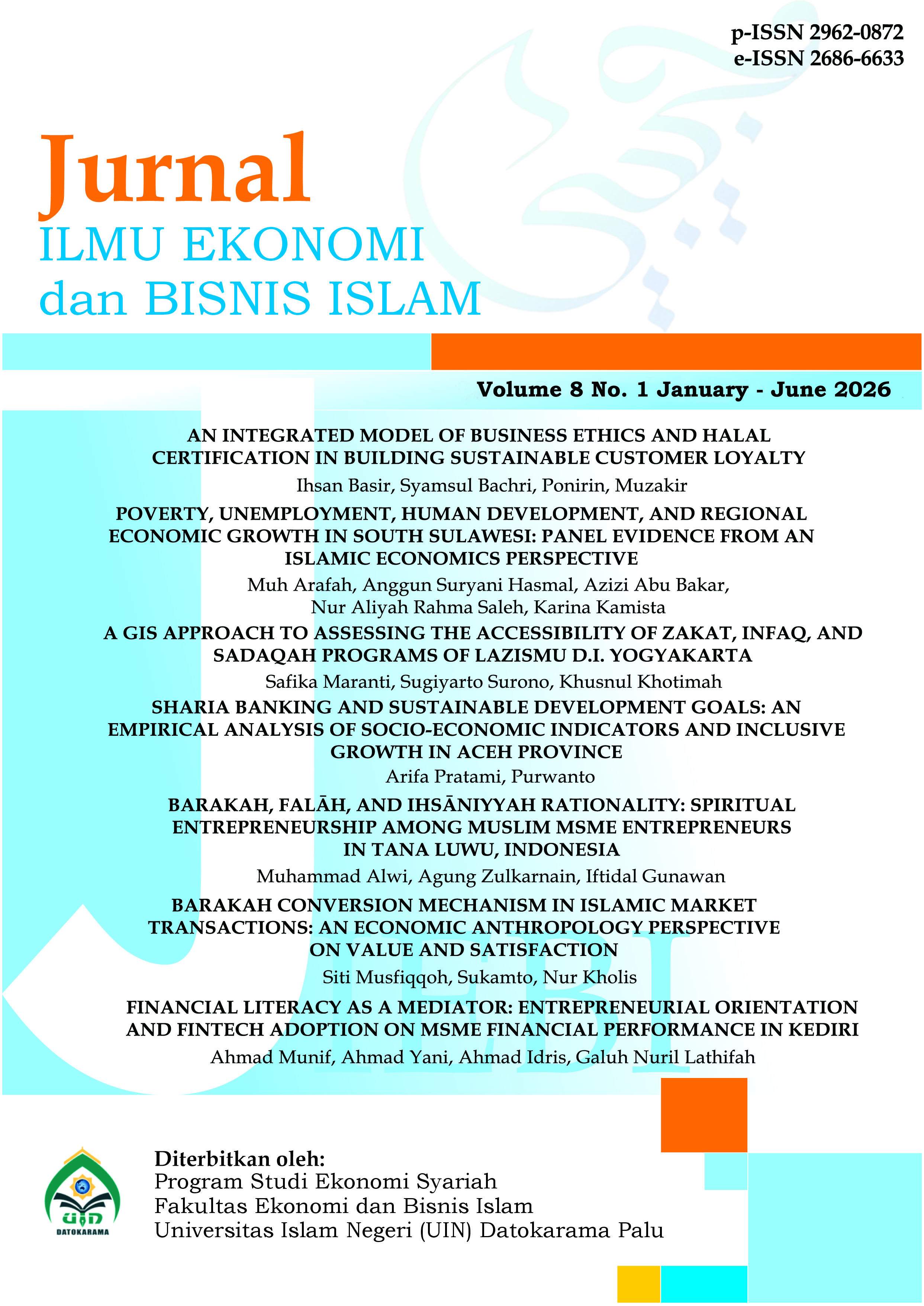
Barakah, Falāḥ, and Iḥsāniyyah Rationality: Spiritual Entrepreneurship Among Muslim MSME Entrepreneurs in Tana Luwu, Indonesia
DOI:
https://doi.org/10.24239/jiebi.v8i1.439.62-81Keywords:
Spiritual entrepreneurship, Islamic business ethics, Barakah, Falāḥ, Muslim MSME entrepreneursAbstract
This study examines spiritual entrepreneurship among Muslim MSME entrepreneurs in Tana Luwu, Indonesia, by analyzing how barakah, falāḥ, and iḥsāniyyah rationality shape everyday economic practices. It addresses a gap in Islamic entrepreneurship studies, which remain largely normative and centered on formal urban business settings, leaving local religious community-based MSMEs underexplored. Using a descriptive qualitative design within an interpretive paradigm, data were collected through in-depth interviews, field observations, and documentation involving 20 Muslim MSME entrepreneurs selected through purposive sampling. Data were analyzed through reduction, presentation, and conclusion drawing, with credibility strengthened through source and methodological triangulation. The findings show that niyyah, amānah, iḥsān, tawakkul, and barakah orientation are embedded in business practices, shaping honesty, halal commitment, trust-based relationships, and resilience amid economic uncertainty. Business success is understood not merely as profit accumulation but as falāḥ-oriented well-being encompassing material, social, moral, and spiritual dimensions. The study introduces iḥsāniyyah rationality as an alternative model of economic rationality and offers a conceptual basis for value-based MSME development and social sustainability within local Muslim economic communities.
References
Abd. Muzakkir. (2021). Mengkonstruksi Spiritual Capital Berbasis Islamic Values Di Dalam Organisasi Bisnis Islam: A Literature Study. Jurnal Ilmu Ekonomi Dan Bisnis Islam, 3(2), 106–123. https://doi.org/10.24239/jiebi.v3i2.56.106-123
Alimusa, L. O., Ma’mun, S. Z., Rahman, A., Nuryadi, A. M., & Latif, S. D. H. (2022). Exploring Factors Determining the Business Performance of Micro and Small Entreprises: Reality in Indonesian Muslim Entrepreneurs. Jurnal Manajemen Bisnis, 13(2), 277–288. https://doi.org/10.18196/mb.v13i2.13930
Alomari, H. M., & Al-Haddad, S. I. (2024). Effect of Islamic Entrepreneurship Mind-programming on Entrepreneurial Performance in Jordan. Jordan Journal of Business Administration, 20(2). https://doi.org/10.35516/jjba.v20i2.2007
Alzeer, J., Rieder, U., & Hadeed, K. A. (2018). Rational and practical aspects of Halal and Tayyib in the context of food safety. Trends in Food Science & Technology, 71, 264–267. https://doi.org/10.1016/j.tifs.2017.10.020
Apipah, N. U., Rosidah, R., Askhiyah, U. M., Tarudi, T., & Abdurrasyid, R. I. M. (2026). Spiritual Values in The Economic Practices of Al-Bahjah Students in Central Cirebon. Jurnal Ekonomi Teknologi Dan Bisnis (JETBIS), 4(11), 746–756. https://doi.org/10.57185/w4rx0187
Author, M. N. (2024). Etika Bisnis dalam Kewirausahaan Santri: Antara Profit dan Keberkahan. Hasina: Jurnal Akuntansi Dan Bisnis Syariah, 1(1), 71–79. https://doi.org/10.35897/hasina.v1i1.1510
Bidaula, Z. S., Maulida, S., & Holilur Rahman. (2024). Entrepreneurship in Islam (Principles and Strategies for the Success of the Prophet Muhammad SAW in Trading). Rihlah Iqtishad: Jurnal Bisnis Dan Keuangan Islam, 1(2), 95–104. https://doi.org/10.61166/rihlah.v1i2.18
Budiyono, S. (2025). Spiritual-Based Entrepreneurship in Pesantren: A Case Study of Pesantren Riyadlul Jannah’s Economic Movement. Islam Realitas: Journal of Islamic and Social Studies, 11(1), 42–58. https://doi.org/10.30983/islam_realitas.v11i1.9255
Cahya, B. T., Munawwaroh, S., Surepno, S., & Andriyanto, I. (2021). The Spiritual Entrepreneur of The Santri Based On Falsafah Local Wisdom Gusjigang In The City of Kudus. Al Tijarah, 7(1), 26. https://doi.org/10.21111/tijarah.v7i1.5636
Chowdhury, N. H., Ayoungman, F. Z., & Tanchangya, P. (2021). Islamic social business: Choice for a Muslim Entrepreneurial career. Revista Argentina de Clínica Psicológica, 30(1), 919–927. https://doi.org/10.24205/03276716.2020.2087
Cordasco, C. L. (2024). The Ethics of Entrepreneurship: A Millian Approach. Journal of Business Ethics, 191(2), 217–229. https://doi.org/10.1007/s10551-023-05489-8
Daradkeh, M. (2023). Navigating the Complexity of Entrepreneurial Ethics: A Systematic Review and Future Research Agenda. Sustainability, 15(14), 11099. https://doi.org/10.3390/su151411099
Desta, C. G. (2018). The Urban Informal Economy in Ethiopia: Theory and Empirical Evidence. Eastern Africa Social Science Research Review, 34(1), 37–64. https://doi.org/10.1353/eas.2018.0001
Ermawati, Y., & Suhardianto, N. (2024). Accounting and Sustainability Practices grounded in Spirituality and Ethics. Atestasi : Jurnal Ilmiah Akuntansi, 7(1), 13–28. https://doi.org/10.57178/atestasi.v7i1.730
Febriyanti, E., Kholid, N., S, M. D. A., & Hartono, R. (2025). The Ethical Values in Islamic Tradition Reinterpreting Morals in the Context of Global Moral Crisis. Bulletin of Science Education, 5(1), 14–32. https://doi.org/10.51278/bse.v5i1.1862
Fry, L. W. (2003). Toward a theory of spiritual leadership. Leadership Quarterly, 14(6), 693–727. https://doi.org/10.1016/j.leaqua.2003.09.001
Furqani, H., & Echchabi, A. (2022). Who is Homo Islamicus? A Qurʾānic perspective on the economic agent in Islamic economics. ISRA International Journal of Islamic Finance, 14(2), 206–220. https://doi.org/10.1108/IJIF-05-2021-0102
Hägg, G., Haataja, V., Kurczewska, A., & McKelvie, A. (2024). Entrepreneurial Responsibility: A Conceptual Framework to Understand Ethical Dualism Throughout the Entrepreneurial Process. Entrepreneurship Theory and Practice, 48(4), 1110–1126. https://doi.org/10.1177/10422587241227072
Hajizadeh, K., & Kazemi, A. (2022). The effect of spiritual marketing and entrepreneurial orientation on determining sustainable competitive advantage: A case study of Soliko Kale Company. Journal of Business and Management Studies, 4(4), 212–223. https://doi.org/10.32996/jbms
Harumi, K., Nugraha, Y., & Kadiyono, A. L. (2021). Workplace Spirituality Ditinjau dari Aspek Demografi: Jenis Kelamin, Tingkat Pendidikan, dan Lama Bekerja di Organisasi. Personifikasi: Jurnal Ilmu Psikologi, 12(1), 71–83. https://doi.org/10.21107/personifikasi.v12i1.8894
Harvey, C., Gordon, J., & Maclean, M. (2021). The Ethics of Entrepreneurial Philanthropy. Journal of Business Ethics, 171(1), 33–49. https://doi.org/10.1007/s10551-020-04468-7
Hidayati, N., Notosudjono, D., & Sunaryo, W. (2023). The Effect of Organizational Culture, Job Satisfaction on Entrepreneurship and Innovativeness in SMEs in Bogor City. The Es Economics and Entrepreneurship, 2(02), 51–60. https://doi.org/10.58812/esee.v2i2.170
Husnul Khitam. (2022). Islam and Capitalism: The Dynamics of Religion and Contemporary Indonesian Work Orientation. Al-A’raf : Jurnal Pemikiran Islam Dan Filsafat, 19(1), 53–74. https://doi.org/10.22515/ajpif.v19i1.5226
Kasim, S., Hamzah, M. N., Kadir, A., & Abdullah, M. W. (2024). Resilience of Micro, Small, and Medium Enterprises Based on Islamic Entrepreneurship. IQTISHODUNA: Jurnal Ekonomi Islam, 13(1), 211–232. https://doi.org/10.54471/iqtishoduna.v13i1.2333
Kasor, A., Pratikto, H., & Winarno, A. (2017). Spiritual Entrepreneurship Education in Islamic Boarding School: A Case Study at Pondok Pesantren Sidogiri Pasuruan, Each Jawa, Indonesia. International Journal of Academic Research in Business and Social Sciences, 7(6), 392–403. https://doi.org/10.6007/IJARBSS/v7-i6/2992
Khamimah, W. (2021). Peran Kewirausahaan Dalam Memajukan Perekonomian Indonesia. Jurnal Disrupsi Bisnis, 4(3), 2017. https://doi.org/10.32493/drb.v4i3.9676
Kummitha, R. K. R., Honig, B., & Urbano, D. (2025). Social Entrepreneurship: A Well-Being Based Approach. Journal of Business Ethics, 200(3), 557–597. https://doi.org/10.1007/s10551-024-05922-6
Kunaifi, A., Djamaluddin, B., Fauzia, I. Y., Ritonga, I., Nurhayati, N., Syam, N., Widiastuti, T., & Ahsan, M. (2024). Islamic Entrepreneurship Identity in The Indonesian Hijrah Community. Multifinance, 2(1), 60–72. https://doi.org/10.61397/mfc.v2i1.140
Kurata, K., Miyashita, S., Sengoku, S., Kodama, K., & Lim, Y. J. (2023). A Comparative Analysis of Social Entrepreneurship and Entrepreneurship: An Examination of International Co-Authorship Networks. Sustainability, 15(22), 15873. https://doi.org/10.3390/su152215873
Kurjono, Juliana, Rika Mardiani, and R. M. (2024). The influence of Islamic values on social entrepreneurship intentions: the moderating role of entrepreneurial education and previous experience. ISAR Journal of Economics and Business Management, 2(8), 31–40.
Lahuri, S. Bin, & Labolo, S. N. S. D. (2023). Comprehending Human Economic Behavior Through a Multicultural Lens: Examining the Concepts of Homo Economicus and Islamicus. Kawanua International Journal of Multicultural Studies, 4(2), 106–117. https://doi.org/10.30984/kijms.v4i2.683
Maharani, D. D. (2020). Implementasi Prinsip-Prinsip Muamalah dalam Transaksi Ekonomi: Alternatif Mewujudkan Aktivitas Ekonomi Halal. Jurnal Hukum Ekonomi Syariah, 3(1), 131. https://doi.org/10.30595/jhes.v0i1.8726
Mardani, D. A. (2019). Spritual Entepreneurship Dalam Pemberdayaan Ekonomi Umat: Studi Terhadap Tarekat Idrisiyah Pageningan Tasikmalaya. Al-Afkar, Journal For Islamic Studies, 4(1), 194–206. https://doi.org/10.31943/afkar_journal.v4i1.68
Margaça, C., Sánchez-García, J. C., Cardella, G. M., & Hernández-Sánchez, B. R. (2022). The role of spiritual mindset and gender in small business entrepreneurial success. Frontiers in Psychology, 13, 1082578. https://doi.org/10.3389/fpsyg.2022.1082578
Ningtyas, T., Saadati, L. N., & Istoni, N. M. (2025). Religious Values as Social Capital for Micro, Small and Medium Enterprises Facing Crisis in Kediri City. Jurnal Sosiologi Agama Indonesia (JSAI), 6(2), 184–201. https://doi.org/10.22373/jsai.v6i2.7827
Osunmakinde, A., Kolade, S., & Mwila, N. (2021). Spiritual capital and social entrepreneurship: a case study of Nigeria. University Research Archive (SHURA).
Othman, N., & Radin A. Rahman, R. S. A. (2020). Malaysian Secondary Students’ Resilience and Entrepreneurial Readiness. Universal Journal of Educational Research, 8(11A), 49–62. https://doi.org/10.13189/ujer.2020.082107
Putri, Nadine Wulan Wijaya Nahya, N., & Inasyah, T. P. (2025). Etika dan Spiritualitas dalam Teori Produksi Ekonomi Islam Menuju Produktivitas Berkelanjutan. Jurnal Ilmiah Ekonomi, Manajemen, Bisnis Dan Akuntansi, 2(4), 131–142. https://doi.org/10.61722/jemba.v2i4.1097
Reyes-Perez, M. D., Carreño Saucedo, L., Sanchez-Levano, M. J., Cabanillas-Palomino, R., Monje-Yovera, P. F., Jaime-Rodríguez, J. P., Atoche-Silva, L. A., Alarcón-Bustíos, J. M., & Fernández-Altamirano, A. E. F. (2025). The Spirituality–Resilience–Happiness Triad: A High-Powered Model for Understanding University Student Well-Being. European Journal of Investigation in Health, Psychology and Education, 15(8), 158. https://doi.org/10.3390/ejihpe15080158
Reza, V. (2022). ISLAMIC ENTREPRENEURSHIP: Membangun Karakter Wirausahawan Muslim dengan Pengetahuan berbasis Ekonomi. Jurnal An-Nahl, 9(1), 1–10. https://doi.org/10.54576/annahl.v9i1.42
Rinawati, I., Anas, M. Y. A., & Manan, Y. M. (2021). Implementasi Etika Bisnis Islam Dalam Perspektif Manajemen Pemasaran. Al Iqtishadiyah Jurnal Ekonomi Syariah Dan Hukum Ekonomi Syariah, 7(2), 126. https://doi.org/10.31602/iqt.v7i2.5706
Safei, A. A. (2021). The formula of Islamic community development in Indonesia through the social entrepreneurship approach. Religious: Jurnal Studi Agama-Agama Dan Lintas Budaya, 5(1), 47–58. https://doi.org/10.15575/rjsalb.v5i1.9685
Sekerka, L. E., & Stimel, D. (2024). Ethics from the Start: Embracing Professional Moral Courage in Entrepreneurial Decision-Making. Business & Entrepreneurship Journal, 13(1), 1–29. https://doi.org/10.47260/bej/1311
Shobir, L. M. (2017). Tasawuf Enterpreneurship: Membangun Etika Kewirausahaan Berbasis prophetic Intelligence. An-Nisbah: Jurnal Ekonomi Syariah, 3(2), 417–432. https://doi.org/10.21274/an.2017.3.2.417-432
Sholihin, M., Sugiyanto, C., & Susamto, A. A. (2023). A systematic review on homo Islamicus: classification and critique. Islamic Economic Studies, 30(2), 121–142. https://doi.org/10.1108/IES-11-2022-0043
Siompu, I., & Asfiah, N. (2024). Islamic Social Entrepreneurship and Work Ethics in Global Business. Formosa Journal of Applied Sciences, 3(7), 2821–2938. https://doi.org/10.55927/fjas.v3i7.9488
Sumpena, M. (2025). Embedding Islamic Ethical Values In Entrepreneurial Decision-Making: From Sharia To Strategy. Jurnal Ilmiah Al-Tsarwah, 8(1), 1–13. https://doi.org/10.30863/al-tsarwah.v8i1.8961
Sutriadi, R., & Miftah, A. Z. (2020). Upaya Mendorong Kolaborasi menuju Pengembangan Struktur Ruang Bernuansa Knowledge Based di Era Disrupsi. TATALOKA, 22(4), 643–662. https://doi.org/10.14710/tataloka.22.4.643-662
Tamalla, A. N., & Fauzi, A. (2021). Strategi Kemandirian Berwirausaha Santri Perspektif Etika Bisnis Islam. Jurnal At-Tamwil: Kajian Ekonomi Syariah, 3(2), 185–198. https://doi.org/10.33367/at-tamwil.v3i2.2231
Urbaniec, M., & Żur, A. (2021). Business model innovation in corporate entrepreneurship: exploratory insights from corporate accelerators. International Entrepreneurship and Management Journal, 17(2), 865–888. https://doi.org/10.1007/s11365-020-00646-1
Uriarte, S., Geldes, C., & Santorcuato, J. (2025). Evolution of Ethics and Entrepreneurship: Hybrid Literature Review and Theoretical Propositions. Journal of Business Ethics, 198(2), 321–343. https://doi.org/10.1007/s10551-024-05815-8
Vu, M. C., & Burton, N. (2022). The Influence of Spiritual Traditions on the Interplay of Subjective and Normative Interpretations of Meaningful Work. Journal of Business Ethics, 180(2), 543–566. https://doi.org/10.1007/s10551-021-04893-2
Wahid, K., & Syakur, A. (2023). Konsep Islamicpreneurship Dalam Pertumbuhan Ekonomi Perspektif Al-Qur’an. ORGANIZE: Journal of Economics, Management and Finance, 2(2), 83–96. https://doi.org/10.58355/organize.v2i2.19
Wahyuddin, W., Amir, A. M. N. A., & Muin, R. (2024). Transformasi Bisnis Sebagai Wahana Ibadah Dan Muamalah Dalam Perspektif Ekonomi Islam. AT-TAWASSUTH: Jurnal Ekonomi Islam, 9(1), 57. https://doi.org/10.30829/ajei.v9i1.20322
Wardani, Y. M., & Ridlwan, A. A. (2022). Penerapan Etika Bisnis Islam dalam membangun Loyalitas Pelanggan pada PT. Tanjung Abadi. JESI (Jurnal Ekonomi Syariah Indonesia), 12(1), 37. https://doi.org/10.21927/jesi.2022.12(1).37-52
Wibowo, B. (2019). Spirituality, Entrepreneurship Education and Entrepreneurial Intention Among Moslem Undergraduate Students: Spiritual Well-Being Scaling Application. Indonesian Journal of Business and Entrepreneurship, 5(2), 118. https://doi.org/10.17358/ijbe.5.2.118
Wulandari, D., Baitussalam, M. I., Basofitrah, A., Maulana, M. A., Ghofur, A., & Sa’diah, I. (2025). Ethical Internalization and the Quest for Barakah: A Socio-Economic Study of Business Integrity among Muslim Entrepreneurs in East Java. HARAMAIN: Jurnal Manajemen Bisnis, 5(02), 265–271. https://doi.org/10.66931/jmb-43
Zhang, J. A., O’Kane, C., & Griffin, D. (2025). What drives micro-entrepreneurs’ value-oriented innovative behavior in microfinance: an entrepreneurial resourcefulness perspective. Small Business Economics, 65(3), 2033–2062. https://doi.org/10.1007/s11187-025-01081-8
Downloads
Published
Issue
Section
License
All submitted article manuscripts must go through all review stages for the journal Jurnal Ilmu Ekonomi dan Bisnis Islam to accept and publish them. By submitting the manuscript, authors agree to the following terms:
- The authors guarantee that the article is original and has not been previously published. The article does not contain illegal statements and does not infringe upon the rights of others. The authors affirm that the article is entirely their own copyright. If there are quotations or references from other sources, authors must obtain written permission and ensure that the quotations are free from third-party rights.
- Authors retain the copyright to their work and grant the first publication rights to the Jurnal Ilmu Ekonomi dan Bisnis Islam under the Creative Commons Attribution-NonCommercial License 4.0 International (CC BY-NC 4.0). This license allows others to share the work while attributing the authorship and initial publication to this journal. However, commercial use of the work is not permitted.
- Authors are permitted to make additional contractual arrangements for non-exclusive distribution of the published journal version. For example, they may submit the article to an institutional repository or publish it in a book, with acknowledgement of the initial publication in this journal.
- Authors are allowed and encouraged to post their work online before and during the submission process. This is considered to promote productive exchange and early and broader citation of published work (see the Influence of Open Access).
 All articles in the Jurnal Ilmu Ekonomi dan Bisnis Islam are licensed under the Creative Commons Attribution-NonCommercial 4.0 International License.


2.png)